The Exorcist III

The most successful of The Exorcist‘s sequels, 1990’s The Exorcist III, belongs largely to author and screenwriter William Peter Blatty. Blatty had adapted his own novel into a screenplay for 1973’s The Exorcist and, in 1983, he wrote his own literary follow-up to The Exorcist, a novel titled Legion. Blatty intended for Friedkin to direct its film adaptation, but Friedkin and Blatty disagreed regarding the vision for the film. Following Friedkin’s departure, Blatty convinced the studio to let him direct. The ensuing production was fraught with difficulty due to studio concerns that Blatty’s original cut of the film was too disconnected from the original film (an approximation of Blatty’s original cut, cobbled from low-quality sources, is now available as a special feature on Exorcist III‘s recent Blu-ray release). Regardless of some of the structural oddities imposed by the film’s reshoots, Exorcist III still feels like a complete expression of a personal vision, a vision that takes a distinctly different vantage point from that of the original Exorcist.

William Friedkin’s original film was the work of an outsider looking in. It regards the dogmas and accessories of Catholicism with fascination, but with cool distance. Faith and evil remain abstract forces, tangible but alien. Blatty, a devout Catholic, gives us an insider’s vision, treating the dogmas and iconography of Catholicism with intimacy and conviction. From the beginning of Exorcist III, in which an evil force comes into contact with a crucifix and awakens it (the eyes of the Christ sculpture snap open in response to the intrusion), Exorcist III treats the accoutrements of Catholic faith as portals to the spiritual world. This impulse peaks during the film’s climactic exorcism, in which the spiritual world and the real world collide in an effects-driven explosion of religious imagery. Accordingly, the desecration of these objects in Exorcist III feels all the more potent; it’s not just the violation of inert symbols, but vital, sacred vessels. In this respect, Exorcist III exists on a kind of trajectory with the horror films of Terence Fisher, which similarly regarded the Christian cross as an embodiment of supernatural good in the war with darkness.

Not that Exorcist III has much stylistic kinship with Fisher’s Hammer horror films, which were marked by restrained, deliberate elegance. Exorcist III‘s adventurous tonal dynamism has little precedent in the mannered Hammer films of the 60s and 70s, nor does it feel connected to the detached, chilly Friedkin original. Exorcist III wildly, but keenly, leaps between comedy and grand, Gothic horror, sometimes blending them both, as it does during a nightmare sequence that serves as both an occasion to delight in absurdity and to underline the story’s existential anxieties. Blatty stubbornly refuses to allow horror to overwhelm the emotional complexity of life. Exorcist III depicts its human relationships with warmth and humor, and the divide between good and evil becomes sharper as a result.

Exorcist III‘s narrative pivots around Lieutenant William Kinderman (George C. Scott), a close friend of the original film’s Damien Karras, who investigates a series of dramatic murders that involve sacrilegious imagery. These murders share the modus operandi the Gemini Killer, who was executed many years prior to these new killings. This investigation leads Kinderman back to the events of the original Exorcist and the dark forces Karras confronted there. The serial killer plot, and a narrative structure relying on lengthy conversations with a menacing foe in an asylum, make Exorcist III a kind of predecessor to 1991’s The Silence of the Lambs, with Exorcist III‘s Gemini Killer (played with manic menace by Brad Dourif) functioning as a supernaturally empowered Hannibal Lecter.

Scott’s Kinderman, however, is no Clarice Starling. He’s a veteran, weary of his position as a soldier on the front lines against corruption. What confronts and startles Kinderman isn’t the reality of evil–Kinderman bellows at darkness with defiance and rage–but eternity. In his final actions, Kinderman acknowledges what his close friend, Father Dyer (Ed Flanders) tells him: “We’re going to live forever, Bill. We’re spirits.” It’s a proposition that Exorcist III shades with both hope and anxiety. The end of time may yet bring an end to the humanity’s nightmares, but the end of time is a long way off.
Sleepy Hollow

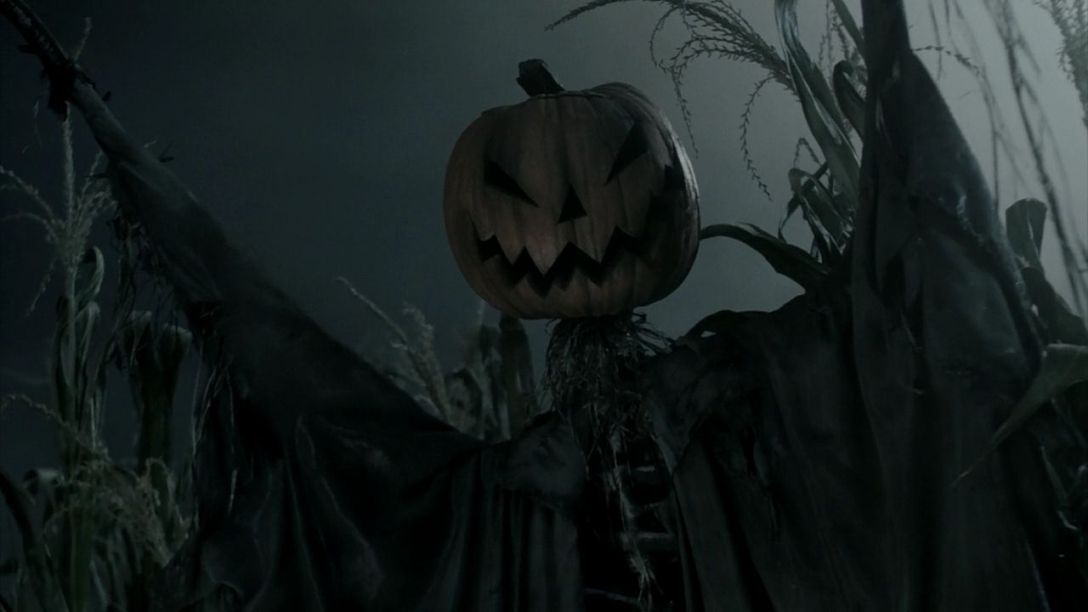
1999’s Sleepy Hollow marked the beginning of the end for director Tim Burton. While its successor, Burton’s ill-fated Planet of the Apes remake, demonstrated that, without a doubt, a once-promising cinematic voice had been devoured by the Hollywood machine, Sleepy Hollow marked the moment when Burton’s style began to shift from vision to mere lacquer.

To be fair, it is, at least in the case of Sleepy Hollow, sumptuously beautiful lacquer, thanks in no small part to the tremendous contributions of cinematographer Emmanuel Lubezki and production designer Rick Heinrichs. Burton gives them plenty to work with as he gleefully takes advantage of the narrative’s opportunities for visual conceits, following after the legacy of Hammer and AIP pictures (with explicit nods in the direction of Brides of Dracula and Pit and the Pendulum). But if Sleepy Hollow is a visual feast, its visual antics feel curiously disconnected from the psychology and emotion of the piece.

Andrew Kevin Walker’s densely plotted screenplay leaves little room for the type of free-wheeling characterization that suits Burton best. Burton’s best films locate witty and brash ways to depict fractured psyches and identity conflicts in visual terms, pursuing emotional throughlines rather than narrative logic. The closest Sleepy Hollow comes to offering a traditional “Burton character” is twitchy, nervous Ichabod Crane (played by Johnny Depp), who has the air of the typical “Burton outsider,” but is little more than a thin assembly of pale face-paint, messy hair, and some odd quirks. The character’s tragic backstory remains awkwardly detached from the rest of the film, as though it was a story change that was imposed on an already-complete narrative. It does little to inform the character or the film itself.

Burton’s impish humor delivers some light laughs, and, even if they’re underused, the cast is crowded with remarkable talents (Martin Landau, Michael Gambon, Ian McDiarmid, Michael Gough, Christopher Lee, and Miranda Richardson among them), but they are insufficient to compensate for a film that has no true center. As such, Sleepy Hollow is far less compelling and memorable than the genre classics to which it pays tribute, films that explored their macabre stylizations with conviction and purpose.

Blade Runner 2049

Through both intention and accident, Ridley Scott’s Blade Runner, a fascinating oddity of Hollywood cinema, wrenched Hollywood spectacle away from classic Hollywood storytelling and produced a new cinematic vocabulary. That this vocabulary has been largely exhausted by Blade Runner‘s numerous heirs has not diminished Blade Runner‘s place as a singular cinematic experience, in part because Blade Runner–a film that was discovered in the messy and confused process of its own making–allows that cinematic vocabulary to have free reign in a way that its successors do not. Blade Runner has always been a beast that its own creators birthed but could not tame. Its nature is its own.

Director Ridley Scott shepherded the development of the sequel, but ultimately saw fit to hand it over to filmmaker Denis Villeneuve (best known for Prisoners, Sicario, and Arrival), who directs the film from a screenplay crafted (in part) by original Blade Runner scribe Hampton Fancher. Blade Runner 2049 builds a narrative web that expands upon the thematic impulses of the original film, finding new roads into the same dilemmas of memory, identity, and artificiality that ran through Blade Runner‘s veins. But, at its worst, Blade Runner 2049 also feels schematic to the point of becoming canned. Unlike the original, its pieces have all been designed to fit within a clear vision.

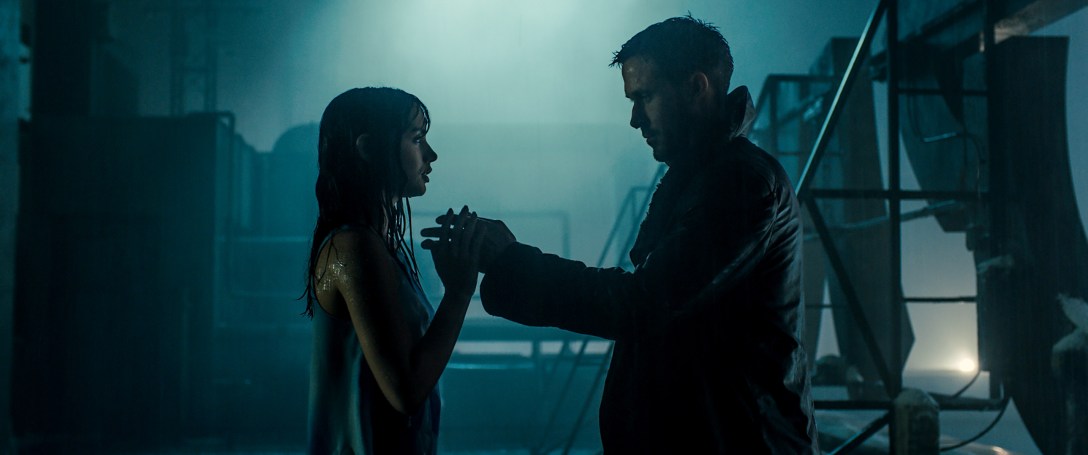
Blade Runner 2049‘s best sequences avoid tracing the lines of Scott’s original, embedding its existential anxieties in new narrative and visual conceits. Many of these moments involve a holographic girlfriend, Joi (Ana de Armas), an artificially intelligent app marketed to the lonely citizens of the film’s dystopian Los Angeles. Joi serves as a kind of nexus for all of Blade Runner 2049‘s meditations on desire and authenticity, an embodiment of the gray area that lies between programming and personhood. In one tender scene, Joi’s holographic avatar freezes in mid-embrace on a rainy rooftop, her intangible caresses interrupted by a phone call that arrives through her same application interface. The moment is sad, funny, and a little unsettling, all the anxieties and longings stirred by human technology incarnate in one beautiful image.

Alas, too often Blade Runner 2049 chases after its predecessor. In the 1982 film, its vistas of dystopian Los Angeles and its inhabitants comprised the actual essence of the film, but here, they often seem more like glossy window dressing, filling up time as the film shuffles us from one plot point to the next. Roger Deakins may be one of the greatest cinematographers working today, but his cinematography here feels unusually flat, as though his efforts were overwhelmed by Blade Runner 2049‘s effects work and the extensive pre-visualization demanded by it.

Given that Blade Runner follows a protagonist whose sense of self unravels as he finds himself enmeshed in the mysteries of the past, it seems unfortunate that Blade Runner 2049 never quite breaks away from its narrative engine to give voice to the emotional tempest at its center. To its credit, its mystery plot, which involves a replicant named “K” (Ryan Gosling, who was born to play an artificial human) avoids many of the more obvious pitfalls that often befalls Hollywood storytelling, but the third act, in which the drive for action beats and competing character agendas become hopelessly entangled, ends up distracting from and diminishing Blade Runner 2049‘s fundamental concerns.

The original Blade Runner had no true antagonist. Blade Runner‘s Roy Batty, a desperate replicant-on-the-run, was a second protagonist whose narrative ran on a parallel track with Deckard’s story until the two tracks converged in its climax. Blade Runner 2049 does not replicate this structure, instead offering up something of a traditional antagonist, a supervillain character named Niander Wallace (Jared Leto). Leto cannot make Wallace work, and, admittedly, I am hard-pressed to think of any actors who genuinely could. Wallace is the sort of character who speaks in riddlespeak pronouncements laced with Biblical language, who arbitrarily kills just to let the audience know that he is, in fact, a Bad Guy. He has Big Plans too, plans that require a lot of sinister action on part of his henchwoman, Luv (Sylvia Hoeks, who, to her credit, attacks her part with uttermost conviction). The more prominent Wallace becomes to the story, the more Blade Runner 2049 moves away from the longings that charge its best moments.

Still, even at its worst, this Blade Runner 2049 does no real disrespect to its predecessor, and the new territory it explores is sufficient to justify its existence. At least some of that new territory belongs to Harrison Ford, who reprises his role as Rick Deckard. Even as the film threatens to reduce his character to a mere MacGuffin, Ford delivers his strongest performance in many years, full of palpable regret and resignation. His bittersweet, tearful reaction to an artifact of the past serves as a strong reminder that the greatest spectacle that cinema can ever offer us is the spectacle of a human face.