Showgirls

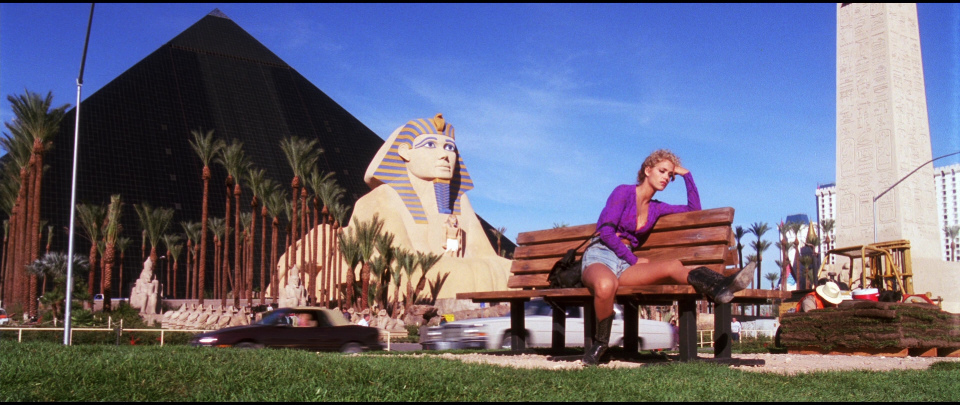
In Showgirls, some people become has-beens, some become grocery clerks, some become forgotten victims obscured by PR cover-ups, and some skip town and head for Los Angeles.

It’s a garish, vulgar, unsubtle epic, but it’s not senseless. It takes talent and chutzpah to make something this brazenly ridiculous, this unflinchingly earnest, and this strange. It’s a movie made for people who, like me, can laugh and cry at the same time.

The Swimmer

No film channels late-summer existential malaise quite like The Swimmer, one of the strangest and most arresting films to come out of 1960s Hollywood.

Awash in high-art pretensions and tacky period affectations–literary pedigree, quasi-psychedelic transition montages, a heavy-handed Marvin Hamlisch score, unsubtle symbolism, untamed melodramatic gestures–The Swimmer somehow survived a troubled production (after clashing with Burt Lancaster, director Frank Perry was pushed off of the project after assembling his first cut, with Sydney Pollack reshooting portions of the film and assembling it into its finished form) to become a vessel for the failures of an American generation, or at least some of them. Set in the midst of wealthy Connecticut, The Swimmer offers a portrait of a masculine mind in crisis, disconnected from time and social structures, frantically tumbling into the liminal regions between hope and delusion and despair. Everything about The Swimmer could easily ring false if it all wasn’t so sincere.

That sincerity extends directly from Lancaster, who gives the greatest performance of his career as Ned Merrill, a proto-Don Draper without any of Draper’s cynicism. Lancaster’s Merrill wholly believes in his own mythology. Lancaster looks and speaks like a god from Olympus; if anyone might speak a daydream into existence, it would be him. But he’s more akin to Sisyphus than he is to one of the Olympians, trying to achieve the impossible through sheer will, only to find that his feats of strength and determination lead him right back to where he started.

But to analyze The Swimmer is considerably less interesting than actually watching it. Its observations about class and race and gender and generational shifts sit on the surface; what makes them powerful are the spiritual energies that flow beneath them. To describe The Swimmer‘s dramatic conceits would fail to capture anything of the film’s uncanniness, in the way it makes its own literariness fluid and vital, in the way it finds both hope and sadness in the promise of summer sunlight, in the way Lancaster’s blue eyes strain to see a world that does not and cannot exist.

Once Upon a Time in Hollywood

“Time is just memory mixed with desire…”
~ Tom Waits, “The Part You Throw Away”

Languorous and fluid, Once Upon a Time in Hollywood floats along currents of longing that seem to come to us straight from deep in Tarantino’s psyche, a place where the Los Angeles of 1969 is real and alive and appealing and sad. Broadly, Once Upon a Time in Hollywood is about Hollywood the Dreamland and Hollywood the Reality and the impossibility of reconciling the two. Or, to take a different perspective, it’s about the impossibility of Tarantino reconciling himself to himself.

Much has been made of the film’s rewriting of history, but I think to receive the climax of this film in the way that you might receive the ending of Inglourious Basterds or Django Unchained completely misses the way this film, unlike those, goes to great pains to set-up its resolution differently; in Basterds and Django, their resolutions were the natural outgrowth of a clear build towards a narrative goal, an expression of catharsis that the entire film had been building toward. This film has no such clarity in trajectory; it ambles about from scene to scene, sequence to sequence, before the finale arrives. When it does arrive, it does so with a sharp tonal shift, and, unlike the prior films, goes out of its way to underline just where this film is breaking away from history. In case you missed his maneuvers before, Tarantino concludes his motion picture with the plaintive, ghostly strains of Maurice Jarre’s cue, “Miss Lily Langtry” (lifted from The Life and Times of Judge Roy Bean), before “Once Upon a Time…” appears on the screen.

Some commentators have lamented that Tarantino isn’t interested in Sharon Tate as a person, but Sharon Tate the Human Being could never be reanimated by a filmmaker, and Tarantino himself is assuredly aware of that fact. One of the film’s most memorable scenes presents us with Margot Robbie-as-Sharon Tate watching the real Sharon Tate on-screen in a film, celebrating the real Sharon Tate while clarifying that whoever Margot Robbie is playing is very much not the real deal. He applies similar exaggeration to every other “real life” figure that appears in this movie (among them, Steve McQueen and Bruce Lee): these figures are the screen icons that live in Tarantino’s mind, not the persons who lived and breathed and died.

Protagonist Rick Dalton, a second-rate actor in the midst of a breakdown, is directly fictionalized, but he, too, is a creation drawn from the biographical details of real-world also-rans that filled Hollywood, as is his stuntman and best-friend, Cliff Booth. Theirs is a dysfunctional, broken bromance, a struggle to navigate a dysfunctional, evolving Hollywood by clinging on to each other. The Hollywood they navigate is Tarantino’s Hollywood: a place alive with the pop culture miscellany that Tarantino adores. Real life intrudes on the nostalgia: this is the home of alcoholics and maybe-murderers, haunted by the dark menace that lives in the abandoned film sets on the fringes of Los Angeles, but it’s also the place where people could drive in cars with the radio blaring and might end up at a theater or drive-in with a luminous marquee that happened to be showing a beat-up film print of a Spaghetti Western. The latter mightn’t balance out the former, but that doesn’t change the depth of love Tarantino has for it.

The fantasy of Once Upon a Time in Hollywood is a fantasy that the also-rans of culture that Tarantino cares about–not just the actors that nobody talks about anymore, but the shows and old theaters and even the radio commercials–actually matter. But in the end, it’s just a daydream, as flimsy as daydreams are. Reality is what it is, and no level of imagination can change it. That won’t stop Tarantino from trying.
Party Girl

Filmmaker Nicholas Ray had a singular talent for distilling desperation into bravura cinema, and his 1958 feature, Party Girl, warps the structures of Hollywood spectacle into a searing portrait of anxious romance. A companion piece to Johnny Guitar that trades the trappings of the Western for 1930s gangster narrativeParty Girl depicts the fragile romance between a showgirl and a mob lawyer, each desperate to escape the dead-end lives they’ve built for themselves.

Party Girl shares some of the DNA of the Cinemascope movie musical, but its core impulses come from the sweaty anxieties of film noir. Party Girl‘s introductory chapter, which shifts from a luminous showgirl number to a menacing mob party to a brutal suicide, anchors all that follows in a state of existential panic and dread. Cyd Charisse’s dance numbers recur throughout the picture are as vividly staged as any to emerge from classic Hollywood, but Ray and his collaborators twist them from crowd-pleasing spectacle to depictions of dangerous desire and entrapment. Charisse’s Vicki Gaye survives by dangling herself before tigers.

For all of its many luminously photographed sequences, the scene that left me reeling is an exterior scene set at a Chicago drawbridge sheathed in darkness, its blue steel beams towering over the film’s lovers, its moving machinery looking like it could crush them at any moment. Speaking with Cyd Charisse’s  Robert Taylor, playing mob lawyer Thomas Farrell, talks mournfully of the foolish machismo of youth and the agonies of aging. Together, they are two people lost in an inhuman city, dreaming of being two different people in some different place.